


Page 22 - Namami Gange 35th Edition
P. 22
The  3rd part  of the  trilogy  is                                Beyond the  trilogy  on Ganga,  the
              ‘Heads  and Tail of Ganga’.                                       Division undertook the preparation
              Authored by Prof. Vijay Paranjpye,                                of a position paper on a lesser
              environmentalist and  mountaineer,                                known aspect, i.e. the riverine islands
              and  sponsored by INTACH,  it                                     of the  Ganga. River islands are a
              weaves  together  an extraordinarily                              neglected facet of Indian rivers and
              broad range of aspects of the Ganga                               surprisingly there is little knowledge
              River. As the title suggests, it covers                           about them.  These  islands,  often
              a large part of the  Ganga River                                  known as tapus, chars, diaras, often
              System  (approximately  10,87,852                                 provide  habitats  and  connecting
              sq.km.),  from   its  uppermost                                   corridors for faunal movement and
              reaches in the snow and ice-covered                               wildlife  refuges. Unfortunately, in
              regions of India and Nepal, lying   conserve Ganga, erasing political
              between  3000  m. and  8000  m.   boundaries  and respecting  basin
              above mean sea level (Heads or   boundaries in the common interest
              Cryoshphere), through its vast river   of all countries.
              basin spread across eleven states
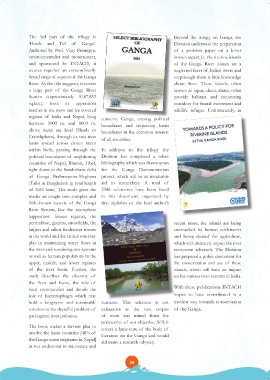
              within India,  passing through  the  In addition to the  trilogy the
              political boundaries of neighboring  Division has completed  a select
              countries of Nepal, Bhutan, Tibet,  bibliography which was drawn upon
              right down to the Sunderbans delta  for the  Ganga Documentation
              of  Ganga Brahmaputra-Meghana  project, which will be an invaluable
              (Tails) in Bangladesh (a total length  aid to  researchers.  A total of
              of 2616 kms). The study gives the  2346  references  have  been  listed
              reader an insight into complex and  in this document,  organized by
              little-known  aspects  of the  Ganga  first  alphabet  of  the  lead  author’s
              River  System,  like  the  cryosphere
              (uppermost frozen regime), the
              permafrost, glaciers, snowfields, the                             recent  times,  the  islands  are being
              largest and tallest freshwater towers                             encroached  by  human settlements
              in the world and the critical role they                           and being cleared for agriculture,
              play  in  maintaining  water  flows  in                           which will ultimately impact the river
              the river and sustaining eco-systems                              ecosystem  adversely.  The  Division
              as well as human populations in the                               has prepared a policy document for
              upper,  middle,  and lower regimes                                the  conservation and use  of these
              of the river basin.  Further, the                                 islands, which will have  an  impact
              study  describes the  diversity  of                               on the various river systems in India.
              the  flora  and  fauna,  the  role  of
              local communities  and details  the                               With these publications INTACH
              role of bacteriophages  which may                                 hopes to have  contributed  in a
              hold a long-term and sustainable  surname.  This selection  is not  modest way towards conservation
              solution to the dreadful problem of  exhaustive as the  vast  corpus  of the Ganga.
              pathogenic river pollution.      of work was mined from the
                                               perspective of our objective. Still, it
              The book makes a fervent plea to   covers a large core of the body of
              involve the basin countries [40% of   literature on the Ganga and would
              the Ganga water originates in Nepal]   aid many a research odyssey.
              in our endeavour to rejuvenate and


                                                            20

