


Page 23 - Namami gange 31st edition-16 printing
P. 23
Industry Insights


                                       Fleshings to tallow:


                              A Waste to Wealth Approach


                     he leather industry has long  drains has an adverse effect on the  from the fleshing, which then starts
                     been known to generate  a  river’s biodiversity, putting  aquatic  to  float  on  top  of  the  reaction
              Tsignificant amount of solid  life in danger.                     chamber. The remaining fatty matter
              and  liquid waste. While the  liquid                              is  separated,  filtered,  and  purified
              waste  can  be treated,  the  disposal   Solidaridad  in collaboration  with   using diluted sulphuric acid, which
              of solid waste has  always been a   National Mission for Clean Ganga is   is readily available in the market.
              challenge.  One of the  major  solid   working towards finding sustainable
              waste  generated during the  pre-  and eco-friendly  alternatives for  The result of this process is tallow,
              tanning  process  is  the  fleshing   the  local tanners  and collection  a valuable commodity in the market
              waste. It accounts for approximately   centres. Solid  waste  management  which  is widely used  in  India  for
                                               in a sustainable manner  is one of  making soap and other products.
              50-60%  of the  total  solid waste   key  focus  areas of Solidaridad  Solidaridad estimates that from every
              generated in the leather industry.
                                               and partners  to  create  win-win   1,000  kilograms  of  wet  fleshings,
              This  fleshing  waste  is  collected  by  propositions for all the stakeholders   around  25-30  kilograms  of tallow
              the  local collection  centres, and is  in the supply chain. Within this, one   can be recovered. By implementing
              typically dried and burnt into ashes  of the primary focus  areas is the   this innovative process, Solidaridad
              and converted into animal  feed.  tallow extraction  process, which   is not only creating  an  economic
              Alternatively, some of the fleshing  involves separating the fatty material   opportunity  for the  local tanners
              waste  is  converted  into tallow  in  from the fleshing waste.   but also reducing the environmental
              an open digester. However, these                                  impact of the leather industry,
              practices  are harmful  for the   The traditional  tallow extraction   particularly  caused  by the  disposal
              environment and unsustainable.   process  is time-consuming  and   of fleshings.
                                               inefficient,  resulting  in  significant
              In  Kanpur, such  issues  have been  waste  of resources. However,   To showcase the efficiency of this
              raised. There is no proper channel  after  conducting  intense  research,   process,  Solidaridad  partnered
              for disposal, and the unsustainable  Solidaridad has managed to increase   with  Super Tannery,  Kanpur,  and
              methods  in practice  lead to many  the  efficiency  and  sustainability   established  a tallow  oil extraction
              problems.  for  example, the  high  of  the  existing  process  by  making   pilot plant demonstration on
              organic content in the waste causes  some modifications to it.    the  premises  of the  footwear
              foul odour, which can create                                      manufacturing  company.   Uttar
              problems for nearby residents.   Solidaridad’s innovative approach  Pradesh  Leather    Industries
                                               involves cooking the fleshing waste  Association (UPLIA)  also helped
              furthermore, the leachate that enters  with steam at a precise temperature.  with the facilitation of the process.
              the  river through neighbouring  This separates the fatty  material  This pilot plant offers an  eco-


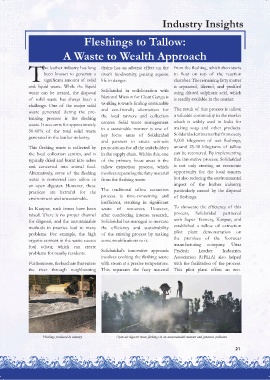
                    Fleshings produced in tannery     Open air digester treats fleshings in an unsustainable manner and generates pollution


                                                                                                            21

