


Page 30 - Patrika 44-Apr-Jun-26 - Sep-1.cdr
P. 30
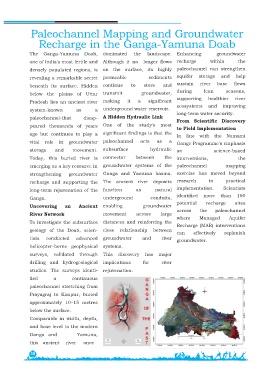
Paleochannel Mapping and Groundwater
Recharge in the Ganga-Yamuna Doab
The Ganga-Yamuna Doab, dominated the landscape. Enhancing groundwater
one of India's most fertile and Although it no longer ows recharge within the
densely populated regions, is on the surface, its highly paleochannel can strengthen
revealing a remarkable secret permeable sediments aquifer storage and help
beneath its surface. Hidden continue to store and sustain river base ows
during lean seasons,
below the plains of Uttar transmit groundwater,
supporting healthier river
Pradesh lies an ancient river making it a signicant
ecosystems and improving
system-known as a underground water reservoir.
long-term water security.
paleochannel-that disap- A Hidden Hydraulic Link
From Scientic Discovery
peared thousands of years One of the study's most
to Field Implementation
ago but continues to play a signicant ndings is that the
In line with the Namami
vital role in groundwater paleochannel acts as a Gange Programme's emphasis
storage and movement. subsurface hydraulic on science-based
Today, this buried river is connector between the interventions, the
emerging as a key resource in groundwater systems of the paleochannel mapping
strengthening groundwater Ganga and Yamuna basins. exercise has moved beyond
recharge and supporting the The ancient river deposits research to practical
long-term rejuvenation of the function as natural implementation. Scientists
identied more than 150
Ganga. underground conduits,
potential recharge sites
Uncovering an Ancient enabling groundwater
across the paleochannel
River Network movement across large
where Managed Aquifer
To investigate the subsurface distances and reinforcing the
Recharge (MAR) interventions
geology of the Doab, scien- close relationship between
can effectively replenish
tists conducted advanced groundwater and river
groundwater.
helicopter-borne geophysical systems.
surveys, validated through This discovery has major
drilling and hydrogeological implications for river
studies. The surveys identi- rejuvenation.
ed a continuous
paleochannel stretching from
Prayagraj to Kanpur, buried
approximately 10–15 metres
below the surface.
Comparable in width, depth,
and base level to the modern
Ganga and Yamuna,
this ancient river once
30

